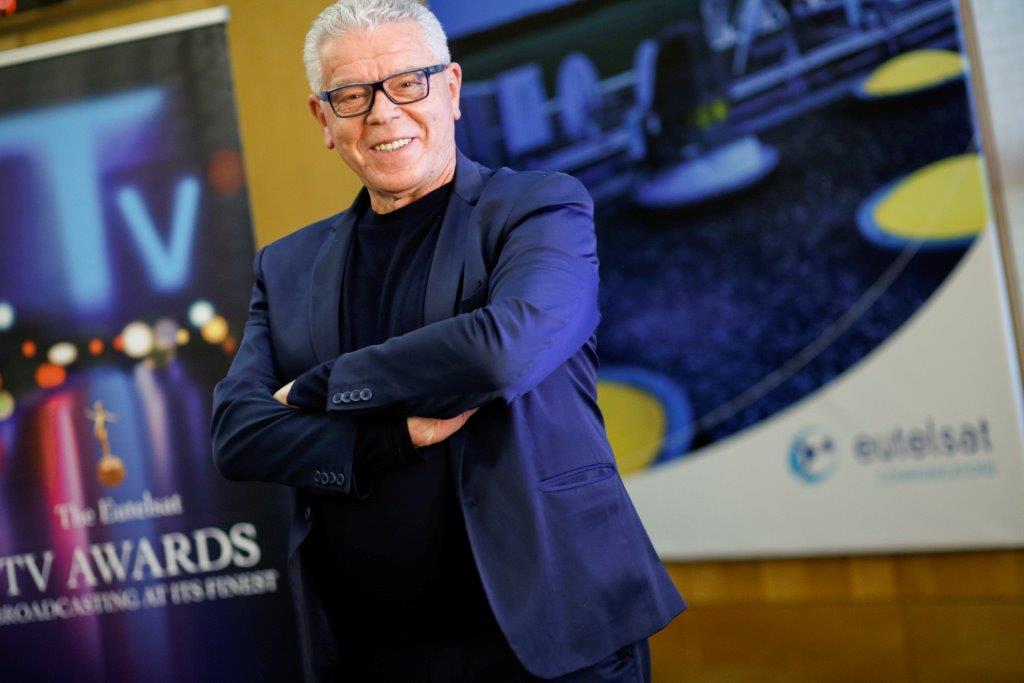
Paolo Dalla Chiara, official portrait provided by the family
Paolo Dalla Chiara, official portrait provided by the family
Paolo Dalla Chiara[1] passed away quietly, with his usual discretion, at the beginning of summer, on Sunday 29 June, when we were all distracted by preparations for the holidays.
He passed away just a few weeks after his great friend and lifelong companion Giuliano Berretta, who died on 26 May, and for whom he had been the voice and arm in Italy for years.
Both had been involved in the Eurovision adventure since its inception, as both Paolo and Giuliano were among those who made European television – which Eurovision deals with – possible.
Giuliano Berretta, in fact, when he was still at ESA, had experimented with prototypes of direct broadcast satellites, such as the one from which the first pan-European channel, simply called Europa TV, was launched[2] . Then, after moving to Eutelsat as Commercial Director, he transformed ESA’s satellite experimentation into one of the success stories of European industry, with the Hot Bird satellite fleet, which brought European countries’ TV channels to Europe, then the world’s TV channels to Europe and finally TV channels from across the Mediterranean basin, North Africa and the Middle East. So much so that today there are over 6,500 TV channels carried by Eutelsat around the world.
But if Berretta was the ‘deus ex machina’ of satellite TV, Paolo was its greatest evangelist, travelling throughout Italy and the Mediterranean to give legs and concrete application to Giuliano’s visions. In 1996, he became Eutelsat’s head of external relations for Italy, contributing significantly to the development of satellite television in Italy. A statistician by training, he reinvented himself as a marketing man for the Vicenza Exhibition Centre (from 1984 to 2015) to help it diversify.
It was his idea to launch Sat Expo in Vicenza in 1994, which very quickly became a leading trade fair for satellite TV throughout Europe. It was also his idea to create a network of antenna installers throughout Italy (complete with a training school: Eurosatellite by Alberto Borchiellini), without which the new method of TV signal distribution would never have taken off. While in Northern Europe satellite TV was limited to feeding cable networks (with essentially ‘BtoB’ distribution), in Latin countries such as Italy, Spain, Greece and the southern shores of the Mediterranean (where cable never existed), this model had to be transformed into ‘BtoC’, convincing not just a few dozen cable network owners, but millions of individual households to install satellite reception antennas.
This was a huge undertaking that required the creation of a widespread network covering not only cities but also villages, even the most remote ones, to allow everyone to install antennas on the roof of their house, in their garden or wherever the signal could be received.
But Sat Expo was not just that. It was much more: it was the place where, once a year, international reflection was brought to Italy, organising (in addition to technical events) conferences, institutional announcements and reflections, and programme reviews. It was here that the idea for HD Forum Italia was born in 2005, which was then established as an association in 2006 to promote the spread of this new broadcasting standard in Italy, which at the time was still only experimental[3] .
It was Paolo himself who, taking up the suggestion of Eurovisioni (by Duilio Giammaria and the author), proposed to Berretta to launch the ‘Hot Bird TV awards’, the first international satellite TV competition reserved for channels broadcast by Eutelsat.
The idea quickly took shape and the first edition was held on the sidelines of Sat Expo in 1998, with an international jury of television critics from Le Monde, La Stampa, Milliyet, Ta nea, Millecanali, TVsat Poland, etc. and was a resounding success, involving hundreds of satellite broadcasters from all over the world every year. Not bad for a project that started from an idea that later proved to be wrong, namely that there was a specific aesthetic for satellite TV, different from that of national TV, whether terrestrial or cable.
Time has shown that no such specific aesthetic existed and that television remained television whether it was distributed via cable or over the air. However, it is true that the intuition was right, especially in the years when the Hot Bird Awards existed (i.e. from 1998 to 2016, although in 2012 they were renamed the Eutelsat TV Awards)[4] . Those were the years when satellite distribution offered new possibilities (but also new challenges) that were previously unknown or unimaginable for national television.
The challenge of multilingualism, for example. Putting a television channel on Eutelsat satellites meant suddenly reaching a potential audience of millions of people across Europe and beyond, in a geographical area of half a billion people speaking over 25 different languages. Satellite television responded to this challenge with great inventiveness, for example by launching music television (where language was less important) or sports television, or even Euronews, which revolutionised language on television by introducing multilingual audio with five tracks, allowing five different audio channels to be combined with a single video signal. This was a technological feat, given that it was still the era of analogue and Betacam production, which had great difficulty in handling five different audio tracks.[5]
But since it was a new market, this offered – as always happens at the beginning of a new technology – opportunities for innovation, or simply for new offerings that could not find sufficient space on terrestrial airwaves (limited to a maximum of 5-6 channels per country) or on cable (with a maximum of 20-30 channels).
During those years, thanks to this incredible window of opportunity, thematic television (as opposed to generalist television) was born, offering the most incredible and imaginative programmes. Although many initially limited themselves to copying the classic American model, which consisted mainly of expanding the range of the most attractive TV genres from generalist TV from a few hours a day to a 24-hour binge on satellite thematic channels.
The US model started with CNN news, Cartoon Network children’s programmes, ESPN sports, National Geographic travel channels, film channels and so on. In Europe, it took the form of similar thematic offerings, but separated by language, given the linguistic fragmentation of the pan-European market. CNN led the way for BBC World Service and Sky News in the UK, a multilingual Euronews offering for the five largest European countries, LCI in France, and CNN Deutschland. Just as HBO became Canal+ and Telepiu in Europe, and Canal Satellite Digital in Spain, ESPN in Europe found itself up against Eurosport, Canal+ Sport, Sky Sports, and so on.
But alongside these classic variations, the emerging satellite TV market has opened up unprecedented opportunities, which the HBA and Eutelsat awards juries have focused their attention on, such as the launch of music channels dedicated to individual genres (from Mezzo for classical music to the ‘Trace’ range of channels dedicated to individual music genres, from rap to urban music), or the Russian channel Boets dedicated solely to combat sports of all kinds (from Greco-Roman wrestling to boxing to catch wrestling to Thai boxing…), or the late Ars TV premium, proposed by Dalla Chiara to Eutelsat and programmed between 1999 and 2002 by Professor Marco Gazzano, one of Italy’s leading experts in video art, who presented the best of world video art on that channel, which at the time was unseen except in the festival circuit. Not to mention the cooking channels, of which Gambero Rosso was one of the pioneers in Italy, soon followed by many others.
The editions of the Hot Bird Awards held in the magical locations of Veneto and Venice were memorable: from Palladian villas to the Scuola Grande di San Giovanni Evangelista, from the former mental hospital on the island of San Servolo, recently converted into a conference centre, to the Roman edition held at the Hilton in Monte Mario.
One might think that we have strayed from the topic. But that is not the case, because the experience of the 19 editions of the Hot Bird Awards – strongly desired and defended by Paolo Dalla Chiara, as well as by Berretta’s successors such as De Rosen – provided a unique snapshot of an extraordinary moment of great richness and experimentation in European audiovisual media. National companies have grown to become continental players (Canal Plus, for example), flagship European channels have developed and grown (France Media Monde, the BBC galaxy, Deutsche Welle, developing different language versions), but also, thanks to the tireless promotional work carried out by the satellite evangelist that was Dalla Chiara, many local TV stations have tried their hand at continental distribution.
Paolo Dalla Chiara, with his family business Pentastudio based in the heart of Vicenza[6] , also served as an icebreaker for Berretta’s brilliant insights, which met with some resistance within the Eutelsat board of directors. Certainly not the more complicated ones, such as the low-orbit satellites that Eutelsat wanted to launch before the arrival of Musk and Bezos, which required continental resources and European political will that never managed to be mobilised, but more modestly with the first European direct-to-home and BtoB connection services with the Tooways system, of which Eutelsat was one of the first global experimenters through the company Open Sky[7] , created by Paolo in 2000, also in Vicenza (later sold in 2018 due to Eutelsat’s decision to exit the sector). This highly innovative service enabled, among other things, the rapid transformation of Italy’s outdated film theatre network into a modern network of digital and multimedia theatres.
Throughout all these years of work, his relationship with Eurovisioni remained one of the cornerstones of his career: from the early 1990s until a few weeks before he left this world to be scattered as ashes on the beloved Asiago plateau. Below is a photo of him with his friends from Eurovisioni at the funeral of his lifelong friend Giuliano Berretta in Rome. No one could have imagined on that day in late May that their destinies would soon be reunited in the place they loved most: the sky. A sky so different from before they filled it with satellites of all kinds, large and small, setting an example for those who then – like Musk and Bezos – exaggerated and launched thousands of them…
Bye Paolo, bye Giuliano: and above all, don’t forget to let us know about the next great technological marvel you’re inventing up there.
Warm regards from Giacomo Mazzone and all your friends at Eurovisioni
_________
[1] Altavilla Vicentina 1942 – Vicenza 2025
[2] Europa TV began broadcasting on 5 October 1985([) (3) (]) ([) (9) (]) and was initially only available in the Netherlands,([)(10) (]) ,but has since extended its coverage to 4.5 million households across Europe via ESA and Eutelsat’s ECS-1 satellite.
[3] https://www.hdforumitalia.it/it/
[4] https://it.wikipedia.org/wiki/Eutelsat_TV_Awards
[5] Euronews broadcasts began with five audio channels for Italian, French, German, Spanish and English audiences.
[6] With a team of young Venetians trained by him and Graziella Pivato, who went on to become highly valued professionals in this sector: from Gladys and Maude dalla Chiara, to Ilaria Pivato, Walter Munarini, Giovanna Mariotto, Paola Antonelli and others whom we are surely forgetting to mention
[7] https://it.wikipedia.org/wiki/Open_Sky